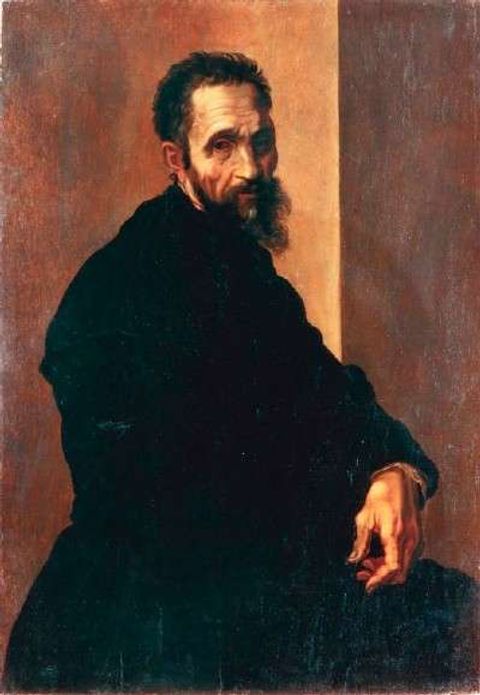


Michelangelo: Biography
Michelagniolo di Lodovico Buonarroti-Simoni, also known as Michelangelo, was born on March 6th, 1475 in Caprese, Italy. His father, Lodovico, belonged to a noble Florentine family. During Michelangelo’s birth, Lodovico was a podestà, a resident magistrate, in Caprese. His term, however, expired within a month. As a result, the family moved back to Florence.
Michelangelo experienced numerous problems with his family. A love-hate relationship grew out of these incidences. When he was ten years old, his father sent him to a foster-mother in Settignano because his mother was not well. During his stay, his mother deceased, and his father remarried. As a result, Michelangelo became very hateful towards his father, but he still respected family as a principle. He found honor in his name and in his father.
Lodovico recognized his boy’s vast intelligence and placed him in school. He hoped that Michelangelo would master Latin. His ambitions, however, favored painting and he became an apprentice to Domenico Ghirlandaio in April 1488. His father was very upset with his choice of profession and believed that painters were laborers.
Within a year, he transferred to Bertoldo’s school of sculpture. His passion for art grew exponentially. Lorenzo de Medici invited Michelangelo to his palazzo where the young artist met numerous leaders of the Renaissance Era.
Michelangelo began studying human anatomy at the Garden of San Marco where he studied human corpses with the permission of the church. Through his studies, he produced The Battle of the Centaurs and the Madonna of the Stairs at the age of sixteen. He became quite known for his artistic ability at a remarkably young age.
After the death of Lorenzo, political instability took over Florence. Michelangelo moved to Rome in the midst of this chaos. In Rome, he studied numerous classical statues and ruins. He produced Bacchus, a large pagan statue. The artist, simultaneously, produced the marble Pietà for Saint Peter’s Basilica at the age of twenty-five.
Michelangelo’s heart remained in Florence, and he moved back to the city as soon as a republic was proclaimed. Arte della Lana, a wool guild in charge of maintaining the appearance of the Cathedral, requested the artist for a giant sculpture. Michelangelo produced his famous David, which embodied Florentine civil ideals. His statue instantly became famous.
In 1508, Julius II called Michelangelo back to Rome for a new project. The artist had to paint twelve apostles with some decorations on the ceiling of the Sistine Chapel. He beautifully spent four years creating the frescoes, but was quite unhappy with his work. In addition, Michelangelo built a tomb for Julius II inside Saint Peter’s Basilica.
Between 1519-1534, Michelangelo built the Medici Tombs for the New Sacristy of San Lorenzo. The tombs were completely different because he sculpted symbols of mankind’s suffering instead of Christian symbols; he portrayed humanity through his scuptures.
In 1534, Michelangelo left Florence for Rome where Pope Clement VII gave him a new project. The artist painted an enormous fresco depicting the Last Judgment in the Sistine Chapel.
Michelangelo received an outstanding offer as an architect for his work at St. Peter’s Basilica, where he was crowned as chief architect in 1546. He viewed this opportunity as a mission entrusted to him by God. He did not accept any payment for this project and happily embraced it even though he was aging.
He spent his last years working on the Rondanini Pietà endlessly. He spent his last years miserably, not capable of sleeping at night. He sadly stated,
"I live alone and miserable, trapped as marrow under the bark of the tree. My voice is like a wasp caught in a bag of skin and bones. My teeth shake and rattle like the keys of a musical instrument. My face is a scarecrow. My ears never cease to buzz. In one of them, a spider weaves its web, in the other one, a cricket sings all night long. My rattling catarrh won't let me sleep. This is the state where art has led me, after granting me glory. Poor, old, beaten, I will be reduced to nothing, if death does not come swiftly to my rescue. Pains have quartered me, torn me, broken me and death is the only inn awaiting me."
Michelangelo died on February 18, 1564 due to a slow fever. His will mentioned that he left "his soul to God, his body to the earth, and his material possessions to his nearest relations." The artist was buried in Santa Croce, and numerous Florentines appeared at his funeral. The citizens of Florence recognized the distinguishing skills that Michelangelo possessed as an artist, and they took great pride in his work.